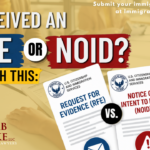
This is a written summary of the “Received an RFE or NOID? Watch This!” YouTube session recorded October 19, 2026
Published October 22, 2026 / Last reviewed October 22, 2026
Quick answer: A Request for Evidence (RFE) asks for more proof before USCIS decides your case. A Notice of Intent to Deny (NOID) tells you USCIS is prepared to deny the case and gives you one opportunity to rebut. Under 8 CFR 103.2(b)(8)(iv), a Request for Evidence response period may not exceed 12 weeks. A NOID response period may not exceed 30 days, and no extensions are allowed. Since USCIS Policy Alert PA-2026-05 (August 5, 2026), we are seeing many RFEs with roughly 30-day deadlines. Below, we cover the difference between the two notices, the trends we are seeing, and how to build a response.
What is the difference between a Request for Evidence and a Notice of Intent to Deny?
A Request for Evidence means USCIS believes your case may be approvable but needs more evidence to show that a legal requirement is met. A NOID means USCIS believes the record already supports a denial and is giving you a chance to show why that conclusion is wrong. Both are issued under 8 CFR 103.2(b)(8).
A Request for Evidence is the friendlier of the two notices: the path to approval is open, but you must support it with evidence. A NOID is a warning that USCIS is on the verge of denying the case.
| Request for Evidence (RFE) | Notice of Intent to Deny (NOID) | |
|---|---|---|
| What USCIS is saying | The case may be approvable, but more evidence is needed | The record supports denial unless you overcome the stated grounds |
| Maximum response period | 12 weeks | 30 days |
| Extensions | Not permitted | Not permitted |
| What to identify first | Each requirement USCIS says is not yet met | Each stated ground for the proposed denial |
When a Request for Evidence or NOID arrives, read it with a pen in hand and mark every requirement or ground for denial USCIS lists. Those statements are your roadmap for the response. A related notice, the Notice of Intent to Revoke (NOIR), applies to petitions that have already been approved and is not covered here.
How long do you have to respond to a Request for Evidence in 2026?
The regulation sets a ceiling, not a fixed period. Under 8 CFR 103.2(b)(8)(iv), “in no case shall the maximum response period provided in a request for evidence exceed twelve weeks, nor shall the maximum response time provided in a notice of intent to deny exceed thirty days.” The same provision states that additional time to respond may not be granted.
Twelve weeks is 84 days. When USCIS serves a notice by mail, 8 CFR 103.8(b) adds three days to the response period, which is why the deadline printed on many mailed RFEs has historically been 87 days.
On August 5, 2026, USCIS issued Policy Alert PA-2026-05, Evidence, Requests for Evidence, and Notices of Intent to Deny, updating Volume 1, Part E of the USCIS Policy Manual. The alert confirms that officers are not required to give the standard 12-week period, and it applies to cases pending on or filed after that date.
In our office, nearly every Request for Evidence we now see carries a deadline of about 30 days, which narrows the practical gap between an RFE and a NOID. The two notices are still not the same. The regulation continues to permit RFE response periods of up to 12 weeks, and a NOID remains the more serious notice because it signals a proposed denial. Either way, treat every RFE and NOID as urgent from the day it arrives.
What should you do first when an RFE or NOID arrives?
- Find the issue date and the response deadline. This is the first thing we check on every notice, because it determines how much time remains for everything else.
- List each requirement or ground USCIS identifies. Every item in a Request for Evidence needs a direct answer supported by evidence.
- Identify evidence that takes time to obtain. Certified court records, medical examinations (Form I-693), and civil documents from abroad often take longer than 30 days. Some courts respond only by mail.
- Contact counsel immediately. A strong legal response takes time to prepare. We recently received a consultation request from someone with three days left to answer a NOID, which left almost no room to build a full record.
- Submit one complete response. Under 8 CFR 103.2(b)(11), all requested materials must be submitted together with the notice. Submitting only some of the requested evidence is treated as a request for a decision on the record.
With a 30-day deadline, one delayed document can be enough to miss the deadline. If no response is received by the deadline, 8 CFR 103.2(b)(13)(i) allows USCIS to deny the case as abandoned, on the record, or both.
How do you build a strong Request for Evidence response?
We approach every Request for Evidence response as a triangle with three parts:
- The legal requirement: what the law requires. For example, a marriage-based petition requires a bona fide marriage.
- The factual assertion: what you claim. For example, the marriage is genuine.
- The evidence: the proof that connects the two, such as joint financial records, photographs, a timeline of the relationship, and letters from family and friends.
The same structure applies across case types. In a parent-child petition where the birth certificate was registered ten years after the child’s birth, the requirement is a qualifying parent-child relationship, the assertion is parentage, and DNA test results can supply the evidence. In an H-1B specialty occupation case, an expert opinion on the position’s requirements may be the evidence that closes the gap. Third-party and expert evidence often carries more weight than the applicant’s own statements.
How do you submit a Request for Evidence response?
Follow the response instructions printed on the notice, including where and how to submit. A well-organized Request for Evidence response makes the officer’s job easy and leaves nothing to chance.
- Put the notice on top. Under 8 CFR 103.2(b)(11), the original notice must be returned with the response.
- Include a cover letter and index. Address each item in the order USCIS raised it, and point to the exhibit that answers it.
- Label every exhibit. Tabbed exhibits let the officer find each document quickly.
- Translate foreign-language documents. Under 8 CFR 103.2(b)(3), every foreign-language document needs a complete English translation, certified by a translator who also certifies competence to translate.
- Send it early and keep proof. Use a trackable delivery method, allow time for delivery before the deadline, and keep a complete copy of everything you submit.
Which documents take the longest to gather for a Request for Evidence?
Start immediately on any item that depends on a third party. These documents can take longer than a 30-day window allows:
- Certified court dispositions, particularly from courts that respond only by mail.
- Foreign civil documents, such as birth, marriage, and divorce records, police certificates, and statements that a record does not exist.
- Medical examinations on Form I-693, which require an appointment with a USCIS-designated civil surgeon.
- Experience letters from former employers, especially employers abroad or employers that have since closed or merged.
- Certified translations of foreign-language documents.
- Affidavits from third parties who live abroad or are difficult to reach.
What Request for Evidence trends are we seeing in family-based cases?
Updated affidavits of support. We have recently received requests for refreshed evidence of a sponsor’s financial ability. This authority is in the regulations. Under 8 CFR 213a.2(a)(1)(v)(B), if more than one year passes between the filing of Form I-864 and the applicant’s interview or examination, an officer may request additional financial evidence and must give at least 30 days to respond.
Discretionary evidence in adjustment cases. When an applicant has a criminal record, such as a DUI, that does not by itself bar adjustment of status, USCIS may still weigh positive and negative factors in exercising discretion. USCIS guidance on this analysis appears in Volume 7, Part A, Chapter 10 of the USCIS Policy Manual. We recommend obtaining certified court dispositions before filing and assembling positive evidence early: tax returns and W-2s, employer letters, letters from family, friends, and religious leaders, and records of volunteer service. A thorough discretionary response can take nearly the full 30 days to prepare.
Bona fide marriage. For Form I-130 marriage petitions, the most common Request for Evidence issue remains whether the marriage is genuine. In our family immigration practice, we prepare this evidence before filing rather than waiting for the request.
What RFE trends are we seeing in employment-based and student cases?
Experience letters for Form I-140. Under 8 CFR 204.5(g)(1), qualifying experience must be documented by letters from current or former employers, and other documentation will be considered if such letters are unavailable. For years, USCIS commonly accepted affidavits from former coworkers when an employer refused to provide a letter. We are now seeing a Request for Evidence in these cases that disregards that secondary evidence and insists on an employer letter.
In one recent case, the beneficiary returned to the former employer that had previously refused, and the employer provided the letter. Even a refusal can help. An email declining to write a letter generally acknowledges that the person worked there, so a negative response can become positive evidence. For more on these petitions, see our page on Form I-140.
Employment-based adjustment. A Request for Evidence on an employment-based Form I-485 follows a pattern similar to family cases when there are criminal, inadmissibility, or prior immigration-violation concerns. A discretionary record should be prepared in advance.
F-1 students. The F-1 classification requires that the student have “a residence in a foreign country which he has no intention of abandoning” (INA § 101(a)(15)(F)(i)). Recent F-1 Request for Evidence notices ask for more evidence of a foreign residence and of the student’s reasons for pursuing the program. Useful evidence includes a lease or deed for the home abroad and statements from family members.
What does a Request for Evidence in an H-1B petition usually address?
In H-1B cases, a Request for Evidence may question whether the position qualifies as a specialty occupation. Under 8 CFR 214.2(h)(4)(iii)(A), the position must meet at least one of four criteria:
- A bachelor’s or higher degree in a directly related specific specialty, or its equivalent, is normally the minimum requirement for entry into the occupation.
- That degree requirement is normal for parallel positions among similar organizations in the employer’s industry.
- The employer, or a third party where the worker will be placed, normally requires such a degree for the position.
- The duties are so specialized, complex, or unique that the knowledge required is normally associated with such a degree.
A strong response ties the actual duties to the degree requirement with specifics: a detailed duty breakdown, the employer’s hiring history for the role, industry evidence, and, where useful, an expert opinion from a qualified professional. The triangle described above applies here as well: the regulation is the requirement, the specialty nature of the job is the assertion, and the duty description and expert evidence are the proof.
What if a birth certificate is not available?
The regulation sets out a sequence. Under 8 CFR 103.2(b)(2)(i), an applicant who cannot obtain a required document, such as a birth certificate, must show that it is unavailable and submit secondary evidence, such as church or school records. If secondary evidence is also unavailable, the applicant must show that and submit two or more affidavits from people who are not parties to the case and who have direct personal knowledge of the event. Under 8 CFR 103.2(b)(2)(ii), unavailability is generally shown by a statement on government letterhead from the relevant authority.
We recommend supplementing a non-availability certificate and affidavits with an early record, such as a school record. A non-availability certificate is also not always the right answer. In some countries, including India in our experience, a birth can often be registered late upon request. Our usual approach is to ask the registrar first and to obtain a non-availability certificate only if the registrar refuses. The Department of State’s Visa Reciprocity and Civil Documents by Country pages describe document availability for each country.
Can a well-prepared filing prevent an RFE or NOID?
Often, yes. A properly and thoughtfully prepared petition can avoid many RFEs and NOIDs. In one recent Form I-130 for a child, our review found that the birth certificate and a supporting affidavit listed different towns as the place of birth. Correcting a foreign document can take far longer than 30 days, so we identified the conflict and had the affidavit corrected before filing.
Preparation matters more after PA-2026-05. Under 8 CFR 103.2(b)(8)(ii), USCIS may deny a case for lack of initial evidence or for ineligibility, and the policy alert restores officers’ discretion to do so without first issuing an RFE or NOID. A filing that relies on USCIS to ask for what is missing now carries a greater risk of denial.
What happens after you respond to a Request for Evidence?
USCIS resumes adjudicating the case once it receives the response. The officer may approve the case, issue a further Request for Evidence or a NOID, or deny it. There is no fixed timeframe for a decision after a response, so keep your mailing address current with USCIS and watch for notices.
What can you do if USCIS denies the case after a Request for Evidence or NOID?
A denial is not always the end of the case, but the deadlines are short. The right option depends on why the case was denied and what type of case it is.
- Motion to reopen. Under 8 CFR 103.5(a)(2), a motion to reopen must state new facts and be supported by affidavits or other documentary evidence. It is filed on Form I-290B, generally within 30 days of the decision under 8 CFR 103.5(a)(1)(i).
- Motion to reconsider. Under 8 CFR 103.5(a)(3), a motion to reconsider must show that the decision was based on an incorrect application of law or USCIS policy, based on the evidence in the record at the time of the decision.
- Appeal to the Administrative Appeals Office. Most employment-based petitions, including Forms I-129 and I-140, fall within the jurisdiction of the Administrative Appeals Office. The appeal is filed on Form I-290B within 30 days after service of the decision under 8 CFR 103.3(a)(2)(i).
- Appeal to the Board of Immigration Appeals. Denials of family-based petitions filed under INA section 204, such as Form I-130, are generally appealed to the Board of Immigration Appeals on Form EOIR-29 within 30 days of service of the decision (8 CFR 1003.1(b)(5) and 1003.3(a)(2)).
- Refiling. Where the missing evidence is now available, filing a new, complete application or petition may be faster than a motion or appeal.
- Federal court review. Some final USCIS denials can be challenged by filing a lawsuit in federal district court. In many cases, you do not have to file an administrative appeal first if the appeal is optional. Federal courts cannot review many discretionary decisions, however, including most decisions on adjustment of status. The Supreme Court has held that this limit also covers the facts behind those decisions (Patel v. Garland, 2022). Because the rules depend on the type of case, decide with counsel whether a motion, an appeal, or a lawsuit is the better path, and act quickly, since some of these options have short deadlines.
Two limits are worth knowing. First, if USCIS denied the case as abandoned because no response was received, 8 CFR 103.5(a)(2) allows a motion to reopen only on narrow grounds, such as showing that the response was in fact submitted on time or that the notice was sent to the wrong address. Second, under 8 CFR 245.2(a)(5)(ii), family- and employment-based Form I-485 denials generally cannot be administratively appealed, although some applicants may renew the application in removal proceedings. Certain other adjustment categories, such as adjustment based on T or U nonimmigrant status, do permit an appeal to the Administrative Appeals Office (8 CFR 245.23(i) and 245.24(f)(2)).
Frequently Asked Questions
Can I get an extension to respond to a Request for Evidence?
No. Under 8 CFR 103.2(b)(8)(iv), additional time to respond to an RFE or NOID may not be granted. The deadline in the notice controls.
What happens if I miss the Request for Evidence deadline?
USCIS may deny the case as abandoned, deny it on the existing record, or both, under 8 CFR 103.2(b)(13)(i).
Can I send part of the evidence now and the rest later?
No. All requested materials must be submitted together. A partial response is treated as a request for a decision on the record under 8 CFR 103.2(b)(11).
Will USCIS always send an RFE before denying my case?
No. Under PA-2026-05, officers have discretion to deny a case for missing initial evidence or ineligibility without first issuing an RFE or NOID.
Can I appeal if USCIS denies my case after a Request for Evidence?
It depends on the case type. Most employment-based petitions can be appealed to the Administrative Appeals Office, family-based petitions such as Form I-130 generally go to the Board of Immigration Appeals, and most family- and employment-based Form I-485 denials cannot be administratively appealed, although certain other adjustment categories permit an appeal. Motions to reopen or reconsider are also available in many cases. Deadlines are generally 30 days.
Is a Request for Evidence a denial?
No. A Request for Evidence means USCIS needs more evidence before deciding. A complete, well-organized response can lead to approval.
Talk to an Immigration Attorney About Your RFE or NOID
How an RFE or NOID should be answered depends on the case type, the grounds USCIS identifies, and the evidence available within the deadline. If you have received a Request for Evidence or a Notice of Intent to Deny, contact Shihab Burke Immigration Lawyers at immigrationvisaattorney.com or 614-791-0500. You can also submit your immigration question for one of our live Q&A sessions at ImmigrationQuestions.US.
This article is for general informational purposes only and does not constitute legal advice. USCIS policy and response deadlines can change, and how they apply to your case depends on your specific facts. Consult a licensed immigration attorney before making decisions based on this information.