Shihab Burke LLC Immigration Lawyers helps families when a U.S. embassy or consulate refuses or holds a spouse visa. Our Columbus 221(g) lawyers review the refusal, prepare the requested documents, and handle communication with the embassy, as requested. From our offices in Columbus and Dublin, Ohio, we serve families in the Columbus area, throughout Ohio, and across the United States, including spouses who live abroad.
Highlights
- A 221(g) refusal is a legal refusal of the visa, but it is often not the end of the case. The embassy can issue the visa later.
- Some 221(g) refusals ask for documents. Others place the case in administrative processing, which means extra background checks.
- Administrative processing can take weeks, months, or longer.
- An officer may send the petition back to USCIS with a recommendation to revoke it.
- There is no formal appeal of a visa refusal, but there are often steps that can help.
+1 (866) 665-0001Schedule Consultation
What Is a 221(g) Refusal?
A 221(g) refusal is a decision by a consular officer that a visa cannot be issued yet. The name comes from Section 221(g) of the Immigration and Nationality Act. The officer usually gives the applicant a letter or form that explains what is needed.
A 221(g) refusal is a legal refusal of the visa, but it is often not the end of the case. In many cases, the embassy issues the visa later, after it receives the missing documents or finishes its background checks.
Our Approach
When a visa is held, we review the entire case, including, for example, the refusal letter and every document sent to the National Visa Center, so the embassy gets what it needs and your family can move forward.
“They always made sure we understood each step, answered all of our questions with patience, and treated us with kindness and respect.”
— Google review
Talk with a Columbus 221(g) spouse visa lawyer: 866-665-0001.
What Are the Types of 221(g) Refusals?
| Type | What it means | What to do |
|---|---|---|
| Document request | The officer needs more documents, such as financial records, civil documents, or proof of the relationship. | Provide exactly what the letter asks for, in the way the embassy instructs. |
| Administrative processing | The case needs more review, such as security or background checks. | Wait for the review to finish. Check the case status online and respond to any new request quickly. |
| Petition returned to USCIS | The officer believes the petition should not have been approved and sends it back to USCIS. | Prepare for a possible Notice of Intent to Revoke from USCIS and respond with evidence. |
What Do the White and Yellow 221(g) Slips Mean?
Many embassies hand the applicant a colored 221(g) form at the end of the interview. At many embassies, a white form means the case needs administrative processing or more documents, and a yellow or other colored form lists documents to provide. The colors and their meanings differ from one embassy to another.
The relative should read the form itself and follow its instructions exactly. The form usually explains what to send, how to send it, and how to check the case status.
How Long Does a 221(g) Refusal Take?
The time depends on the type of 221(g) refusal. A document request can be resolved soon after the documents are received. Administrative processing often takes several weeks to several months, and some cases take longer.
If the embassy asks for documents, the relative usually has one year from the refusal to provide them. After that, a new application and fee may be needed. A case waiting in administrative processing is not closed because of the wait.
What Is a Notice of Intent to Revoke (NOIR) for an I-130?
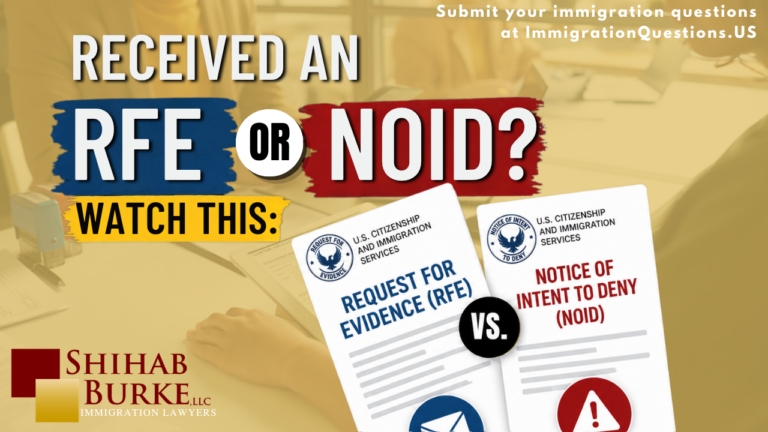
A Notice of Intent to Revoke (NOIR) is a written notice from U.S. Citizenship and Immigration Services (USCIS) saying that USCIS plans to cancel the approval of a petition, such as Form I-130. The NOIR explains the reasons and gives the petitioner a chance to respond with evidence before USCIS decides.
A consular officer may send the approved petition (Form I-130) back to U.S. Citizenship and Immigration Services (USCIS) with a recommendation to revoke it. This often happens when the officer doubts that the marriage is real. Returned petitions can wait a long time before USCIS reviews them.
When a returned petition reaches USCIS, USCIS can do one of three things:
- Reaffirm the petition and send it back to the National Visa Center and the embassy
- Send the U.S. citizen or green card holder a Notice of Intent to Revoke
- Revoke the petition automatically, in limited situations set by law
The NOIR states the deadline to respond. The response should answer every reason in the notice with strong evidence, such as proof of a real, shared marriage and sworn statements. USCIS may allow more time for a good reason, such as documents that must come from another country, but the petitioner must ask before the deadline.
If the response does not overcome the reasons, or no response is sent, USCIS revokes the approval in a written decision on Form I-292. The petitioner can appeal the revocation to the Board of Immigration Appeals (BIA). The appeal deadline is short, as little as 15 days, and is stated in the decision. Learn more on our I-130 denial appeal page.
Most courts have held that a final USCIS decision to revoke a petition cannot be reviewed in federal court. For this reason, the NOIR response and the BIA appeal are often the most important chances to save the case.
Our attorneys respond to Notices of Intent to Revoke and file revocation appeals with the BIA. Learn more on our marriage green card NOID page and our marriage fraud allegation page.
What Does “Intent to Revoke Notice Was Sent” Mean?
“Intent to Revoke Notice Was Sent” is a USCIS online case status message. The message means USCIS mailed the petitioner a Notice of Intent to Revoke. The petitioner should watch for the notice, read it carefully, and note the response deadline. If the notice does not arrive, the petitioner should contact USCIS and a lawyer right away, because the deadline runs from the date of the notice.
What If the Visa Is Refused for Another Reason?
A visa can also be refused under other parts of the law, such as past unlawful presence in the United States, a misrepresentation, or certain crimes. Some of these refusals can be overcome with a waiver. Learn more on our I-601A and I-601 waivers page.
When administrative processing lasts much longer than usual, a lawsuit asking a court to order a decision may be possible in some cases. Learn more on our delayed case and mandamus page.
How Our Columbus 221(g) Lawyers Help
A visa refusal calls for a review of the whole case, not only the refusal letter. We review, for example, the refusal letter, the documents sent to the National Visa Center, the interview, and any past visa refusals or time in the United States. We then explain honestly what is likely causing the hold and what can be done. This approach does not guarantee that a visa will be issued, but it helps make sure the embassy receives a complete and clear response.
We:
- Review the refusal letter and explain what it means
- Prepare and organize the documents the embassy requests
- Handle communication with the embassy, at your request
- Follow up on long administrative processing, at your request
- Respond to a Notice of Intent to Revoke and appeal a revocation to the BIA
- Review whether a waiver or a mandamus lawsuit may help
Every family case is different. At the consultation, we review your situation, explain what our representation will cover, and quote a fee. Most cases are handled for a flat fee.
Frequently Asked Questions About 221(g) Refusals
Is a 221(g) refusal a denial?
A 221(g) refusal is a refusal, but often not a final one. The visa cannot be issued yet, but many visas are issued after the documents are provided or the background checks are finished.
Can a 221(g) refusal be appealed?
No. There is no formal appeal of a visa refusal. The usual steps are to provide the requested documents, wait for administrative processing, or, in some cases, apply for a waiver.
How do we check the status of a 221(g) case?
The relative can check the immigrant visa case status on the Department of State’s Consular Electronic Application Center (CEAC) website, using the case number.
Can a lawyer attend the embassy interview?
Lawyers generally do not attend immigrant visa interviews at U.S. embassies and consulates per State Department policy. Our attorneys prepare the relative for the interview and handle communication with the embassy.
How do I respond to a Notice of Intent to Revoke an I-130?
Read the notice carefully, note the deadline, and answer every reason it gives with strong evidence. In a marriage case, the evidence usually shows a real, shared life, such as joint finances, a shared home, photos over time, and sworn statements. A lawyer should review the notice and the full file, including the consular officer’s findings, before the response is sent.
Can I appeal an I-130 revocation?
Yes. A petitioner can usually appeal the revocation of an approved Form I-130 to the Board of Immigration Appeals (BIA) on Form EOIR-29. The deadline is short, as little as 15 days, so the petitioner should contact a lawyer as soon as the revocation decision arrives.
Can we sue over a long 221(g) delay?
In some cases. A mandamus lawsuit asks a federal court to order the government to decide a case. Courts are divided on these lawsuits for embassy delays, so each case needs a careful review.
Recent Changes Affecting Spouse Visas
These recent changes affect spouse visa cases at U.S. embassies and consulates. We update this section whenever possible.
- Travel restrictions. Since January 1, 2026, a presidential proclamation has limited visas for people from 39 countries. The proclamation does not have a general exception for spouses of U.S. citizens.
- End of the 75-country pause. In January 2026, the State Department stopped issuing immigrant visas to people from 75 countries. A court order ended that pause on August 21, 2026.
- Worldwide interview pause. In late August 2026, the State Department paused most immigrant visa interviews worldwide for officer training on the public charge rules. Some embassies have restarted interviews, but many have not. Families should check with the embassy before making plans.
- Interviews in the country of residence. Immigrant visa applicants are generally interviewed at a U.S. embassy or consulate in the country where they live.
Related Videos and Articles
- Consular Processing vs. Adjustment of Status: Which Is Right for You? (video)
- Notice of Intent to Revoke: 4 Ways to Respond to a USCIS NOIR (article)
Talk With a Columbus 221(g) Spouse Visa Lawyer
Our Columbus office is at 4449 Easton Way #200, Columbus, OH 43219. Our Dublin, Ohio office is at 565 Metro Pl S #100, Dublin, OH 43017. Both offices are open by appointment only, Monday through Friday, 9 a.m. to 5 p.m.
Contact our Columbus or Dublin, Ohio office, or call 866-665-0001, to schedule a consultation in person, by phone, or by video conference.