Shihab Burke LLC Immigration Lawyers helps relatives of U.S. citizens and green card holders apply for a family-based green card without leaving the United States. This process is called adjustment of status. Our Columbus adjustment of status lawyers review eligibility, prepare the full application, and prepare clients for the interview. From our offices in Columbus and Dublin, Ohio, we serve families in the Columbus area, throughout Ohio, and across the United States, including relatives who live abroad.
Highlights
- Adjustment of status means applying for a green card from inside the United States on Form I-485.
- Most applicants must have entered the United States legally, after inspection by an immigration officer.
- Spouses, unmarried children under 21, and parents of U.S. citizens can usually file Form I-130 and Form I-485 together.
- Applicants can ask for a work permit and travel permission while the case is pending.
- Leaving the United States without travel permission while the case is pending usually ends the application, with some exceptions.
+1 (866) 665-0001Schedule Consultation
What Is Adjustment of Status?
Adjustment of status is the process of applying for a green card without leaving the United States. The relative files Form I-485, Application to Register Permanent Residence or Adjust Status, with U.S. Citizenship and Immigration Services (USCIS). A green card holder is also called a lawful permanent resident.
A relative who lives outside the United States uses consular processing instead. Consular processing means applying for an immigrant visa at a U.S. embassy or consulate. Learn more on our consular processing page.
Our Approach
Before we file, we review your entire immigration history and records, including, for example, how you entered the United States and your police records, so your green card case can move forward with confidence.
“…went much deeper than expected to get the evidence for eligibility and filed our MTR with confidence, getting my case approved.”
— Google review
Talk with a Columbus adjustment of status lawyer: 866-665-0001.
Who Qualifies for Family Adjustment of Status?
A relative usually qualifies for family adjustment of status if all of these are true:
- The relative is the beneficiary of a family petition (Form I-130). The beneficiary is the relative being sponsored. The petition can be filed earlier or together with Form I-485.
- A visa is available. Immediate relatives of U.S. citizens always have a visa available. Other relatives must wait until their priority date (place in line) is current in the Visa Bulletin.
- The relative was inspected and admitted or paroled into the United States. This means an immigration officer checked the relative at entry.
- Nothing else bars the relative, such as certain crimes or past immigration fraud.
Can a Relative Adjust Status After Overstaying a Visa?
It depends on the relationship. Immediate relatives of U.S. citizens who entered legally can usually adjust status even if their permission to stay has expired, and even if they worked without permission. Immediate relatives are spouses, unmarried children under 21, and parents of U.S. citizens.
Relatives in the family preference categories usually must have kept legal status and must not have worked without permission. A relative who entered without inspection usually cannot adjust status. An older law, Section 245(i), may help some people for whom a family or work petition was filed on or before April 30, 2001.
There is a concern if a relative entered the United States as a visitor or student while already planning to stay. That can be treated as misrepresentation, which means lying to the government. A relative in this situation should talk to a lawyer before filing.
Can Form I-130 and Form I-485 Be Filed Together?
Yes, in many cases. Filing both forms at the same time is called concurrent filing. Immediate relatives of U.S. citizens can always file Form I-130 and Form I-485 together, because a visa is always available to them.
Relatives in the preference categories can file Form I-485 only when their category is current. “Current” means the Visa Bulletin, a monthly report from the U.S. Department of State, shows that an immigrant visa is available for the relative. Each month, USCIS also announces which of the two Visa Bulletin charts applicants may use to file, called the filing charts.
My Priority Date Is Current. What Happens Now?
A priority date is the relative’s place in line. A priority date is current when it is earlier than the date listed for the relative’s category and country in the Visa Bulletin, the State Department’s monthly chart. When the priority date is current, the relative can take the next step toward a green card.
- Check the right chart. The Visa Bulletin has two charts: Final Action Dates and Dates for Filing. Each month, USCIS says which chart applies to green card applications filed inside the United States.
- Relatives in the United States. An eligible relative may file Form I-485 to apply for a green card through adjustment of status.
- Relatives abroad. The National Visa Center (NVC) asks the relative to pay the fees, complete Form DS-260, and upload documents. The sponsor files the Affidavit of Support.
- Children close to age 21. Under the Child Status Protection Act, a child may need to apply within one year after a visa becomes available to protect the child’s age. Learn more on our Child Status Protection Act page.
Families should act promptly. If the relative does not contact the National Visa Center for one year after being notified that a visa is available, the NVC may close the case and the petition may be cancelled.
We review each case when the priority date becomes current and prepare the next filing.
K-1 Adjustment of Status
K-1 adjustment of status is the green card application a K-1 fiancé(e) files after marrying the U.S. citizen who filed the K-1 petition. No new Form I-130 is needed if the couple married within 90 days after the fiancé(e) entered the United States. If the marriage happened later, the U.S. citizen must file Form I-130 for the spouse. A K-1 visa holder cannot adjust status through marriage to anyone else. Learn more on our K-1 fiancé(e) visa page.
What Is Included in an Adjustment of Status Application?
A family adjustment of status application usually includes:
- Form I-485, Application to Register Permanent Residence or Adjust Status
- Form I-864, Affidavit of Support, with the sponsor’s tax returns and proof of income
- Form I-693, the medical exam report, completed by a USCIS-approved doctor and filed with the application, if a medical exam is required
- Form I-765, to request a work permit, if wanted
- Form I-131, to request advance parole (travel permission), if wanted
- Birth certificate, passport, entry record (Form I-94), and photos
- Certified court records for any arrest or conviction
What Are the Steps After Filing for Adjustment of Status?
- USCIS sends a receipt notice for each form.
- The applicant attends a biometrics appointment for fingerprints and a photo.
- USCIS decides the work permit and travel permission requests, if filed.
- USCIS usually schedules an interview at the field office that serves the area where the applicant lives. Applicants who live in the Columbus area are usually interviewed at the USCIS Columbus Field Office. Our attorneys represent clients at USCIS interviews at any USCIS office in the United States. Learn more on our marriage green card interview page.
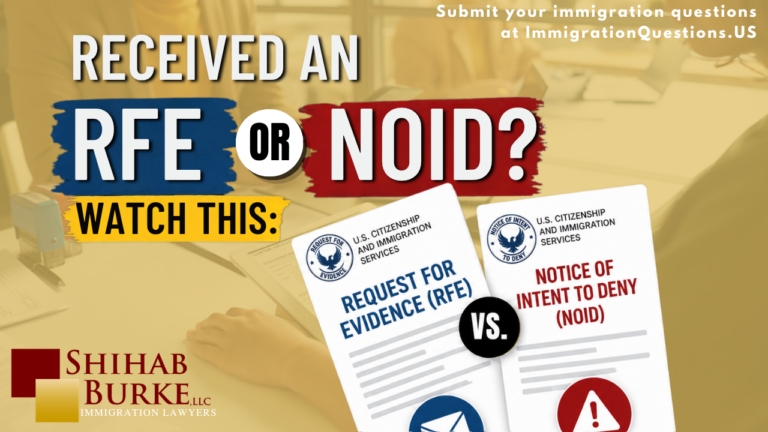
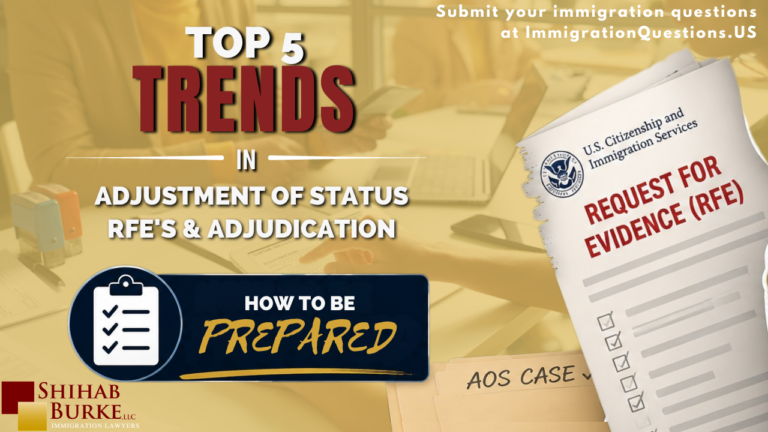
- USCIS decides the case. USCIS may approve the application or deny it. Before deciding, USCIS may send a Request for Evidence (RFE), which asks for more documents. USCIS may also send a Notice of Intent to Deny (NOID), which warns that the case may be denied.
- If approved, the applicant becomes a permanent resident, and the green card arrives by mail. A spouse whose marriage is less than two years old on the approval date receives a two-year conditional green card.
How Long Does Adjustment of Status Take?
How long adjustment of status takes depends on the USCIS office, the type of case, and whether USCIS asks for more evidence. Processing times change often and are different at each USCIS office.
The USCIS Case Processing Times page shows the current time for Form I-485 at each office. We give each client a current estimate at the consultation. A complete, well-organized application helps avoid delays caused by Requests for Evidence.
Can I Work and Travel While Adjustment of Status Is Pending?
An adjustment of status applicant can work after USCIS approves the work permit (Employment Authorization Document, or EAD). The applicant can request the work permit by filing Form I-765 with the green card application.
An applicant should not leave the United States without advance parole while the application is pending. Advance parole is travel permission from USCIS. Leaving without it usually causes USCIS to treat the green card application as abandoned, with some exceptions. Even with advance parole, travel can be risky for people with past immigration problems, so an applicant should talk to a lawyer before any trip.
What Happens If Adjustment of Status Is Denied?
Most denied adjustment of status applications cannot be appealed, because the law allows appeals only in limited cases. The applicant may be able to file a motion to reopen or reconsider with USCIS, or file a new application if eligible. A denial can also lead USCIS to issue a Notice to Appear, the document the government uses to start a case in immigration court. Learn more on our denied green card page.
What Are the Government Fees for Adjustment of Status?
We update this information regularly, but government filing fees have changed frequently in recent years. The amounts below are provided for general information only and should not be relied on for a filing. For every case we file, our office calculates the applicable government fees and informs the client of the exact amounts at the time of filing.
The main government fees for family adjustment of status are:
| Form or Service | Government Fee |
|---|---|
| Form I-130, Petition for Alien Relative (if filed together) | $675 by mail; $625 online |
| Form I-485, Application to Adjust Status | $1,440 (age 14 and older); $950 (under 14, filing with a parent) |
| Form I-765, work permit, filed with a pending Form I-485 | $260 |
| Form I-131, advance parole | $630 |
| Medical exam (Form I-693) | Set by the USCIS-approved doctor |
Current amounts are listed on the USCIS fee schedule (Form G-1055) and on the Department of State’s Fees for Visa Services page.
How Our Columbus Adjustment of Status Lawyers Help
Our attorneys handle the full adjustment of status case. We:
- Confirm eligibility, including how the relative entered and any past status problems
- Prepare Forms I-130, I-485, I-864, I-765, and I-131 and the supporting evidence
- Review police records and civil documents before filing
- Respond to Requests for Evidence and Notices of Intent to Deny, at your request
- Prepare the applicant, and the spouse in marriage cases, for the interview
Our attorneys represent clients at USCIS interviews at any USCIS office in the United States. For cases at any U.S. embassy or consulate, we prepare the relative for the interview and handle communication with the embassy.
Our team reviews every part of an adjustment of status case before filing. This includes, for example, how the applicant entered the United States, any gaps in status, police and court records, and the sponsor’s income, and we confirm that all forms and fees are correct. Because USCIS can now deny some cases without first asking for more evidence, a complete review helps reduce risk. We give you an honest assessment of your options, so you can be confident that your case presents your family’s situation clearly and that your family can move forward.
Every family case is different. At the consultation, we review your situation, explain what our representation will cover, and quote a fee. Most cases are handled for a flat fee.
What Our Clients Say
“…an outstanding experience with my Family Based Adjustment of Status from start to end.”
— Google review
“[The attorney] has been incredibly helpful and efficient throughout our immigration journey. He assisted my husband and me with my K1 visa, and now he’s helping us with my Adjustment of Status (AOS).”
— Google review
Frequently Asked Questions About Adjustment of Status
How long does adjustment of status take?
Adjustment of status time depends on the USCIS office, the type of case, and whether USCIS asks for more evidence. Processing times change often. The USCIS Case Processing Times page shows the current time for Form I-485 at each office. We give each client a current estimate at the consultation.
Can I work while my adjustment of status is pending?
Yes, after USCIS approves the work permit. An adjustment of status applicant can request a work permit by filing Form I-765 with the green card application.
Does the medical exam have to be filed with Form I-485?
If a medical exam is required, Form I-693, the medical exam report, must be filed together with Form I-485. Some applicants do not need a new exam. For example, certain K-1 and K-2 visa holders may rely on the medical exam they had abroad and submit only their vaccination records.
Can a parent of a U.S. citizen adjust status?
Yes, if the U.S. citizen is at least 21 years old and the parent meets the other requirements, such as legal entry. Parents of U.S. citizens are immediate relatives, so a visa is always available to them.
Can someone who entered without inspection adjust status?
Usually not. A relative who entered without inspection usually must apply for an immigrant visa abroad, often with a provisional waiver filed first. Some people protected by Section 245(i) are an exception. Learn more on our waivers page.
Can a lawyer attend the adjustment of status interview?
Yes. A lawyer may attend the USCIS interview with the applicant. Our attorneys represent clients at USCIS interviews at any USCIS office in the United States.
How do I check the status of my I-485 application?
An applicant can check I-485 status online with the 13-character receipt number on the USCIS receipt notice. The receipt number can be entered on the USCIS Case Status Online page or viewed in a USCIS online account. USCIS also posts processing times for each form and office. Our office tracks each client’s case and explains each USCIS notice.
Will using Medicaid affect my green card application under the public charge rule?
It may. The public charge rule changed for green card applications filed inside the United States on or after September 18, 2026. Whether Medicaid matters can depend on the type of Medicaid, who received it, and when. Benefits received by U.S. citizen family members are treated differently from benefits received by the applicant. An applicant who has used Medicaid or other public benefits should speak with a lawyer before filing Form I-485.
Recent Changes Affecting Adjustment of Status
These recent changes affect adjustment of status cases. We update this section whenever possible.
- Closer review of positive and negative factors. In May 2026, USCIS told officers to look more closely at positive and negative factors before approving a green card inside the United States.
- New public charge rule. Since September 18, 2026, officers may look at the applicant’s whole situation, including public benefits based on low income received on or after that date. The rule applies to Form I-485 applications postmarked or submitted online on or after September 18, 2026.
- Denials without a warning. Since August 5, 2026, USCIS may deny a case without first sending a Request for Evidence or a Notice of Intent to Deny. This can happen when the required initial evidence is not submitted with the application.
Related Videos and Articles
- Adjustment of Status Filing Best Practices (video)
- When Will USCIS Approve My Adjustment? (video)
- Analyzing USCIS’s Latest Adjustment of Status Discretion Memo (video)
- Adjustment of Status Frequently Asked Questions (video)
- 5 Ways to Get Your Adjustment of Status Moving Forward (article)
Talk With a Columbus Adjustment of Status Lawyer
Our Columbus office is at 4449 Easton Way #200, Columbus, OH 43219. Our Dublin, Ohio office is at 565 Metro Pl S #100, Dublin, OH 43017. Both offices are open by appointment only, Monday through Friday, 9 a.m. to 5 p.m.
Contact our Columbus or Dublin, Ohio office, or call 866-665-0001, to schedule a consultation in person, by phone, or by video conference.